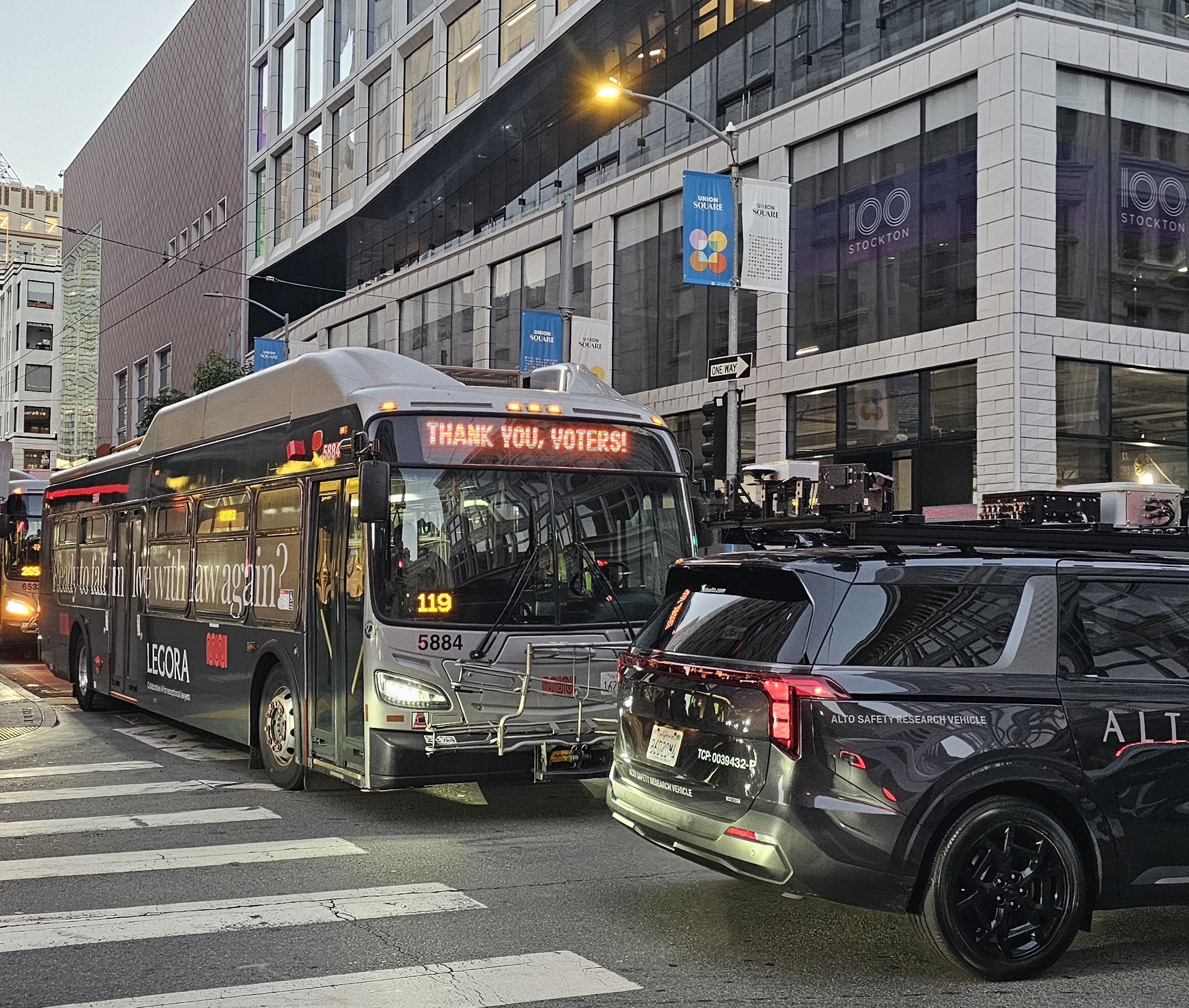
The featured photo depicts a juxtaposition that invited capture — the current Muni headsign du jour, thanking voters for approving the transit funding measures, while announcing a bus that is stuck in traffic. Forcing transit vehicles to idle in persistent traffic congestion, as so many buses in the Bay Area do on a daily basis, is not only an irritance that delays riders and impedes service reliability. It is also pouring money down the drain, at a time when (as we have been persistently reminded these past many months leading up to the election) Muni and our other regional transit agencies can scarcely afford to do so.
In contrast, when transit vehicles can travel on paths unimpeded by cars, a given level of service can be operated with fewer transit vehicles and operators, as the full length of the route can be traversed more quickly. That means existing service levels can be maintained at lower operating cost, or service levels could even be enhanced at no (or at least reduced) additional cost.
In other words, keeping buses and trains moving through traffic is itself a budget efficiency measure — to say nothing of the additional ridership and fare revenue that more functional and reliable transit service would attract.
San Francisco voters approved not just one, but two, transit funding measures on the very same ballot — the regional transit measure (RTM), in support of other Muni and other regional transit operators, and the city’s Proposition H, a parcel tax specifically in support of Muni service. The success of both transit measures, combined with the defeat of Proposition G’s attempt to revive the Great Highway, together deliver an unequivocal voter mandate to advance our public transit system and sustainable transportation more broadly.
Throughout this year leading up to the election, Mayor Lurie’s office has tiptoed around progressive transportation initiatives like a political third rail, tending toward extreme caution in advance of the vote on Muni funding. But we, the voters, have now done our part to fund our transit system — so it it is time for the City do its part in putting funds to the best possible use. For the reason described above, allowing buses, streetcars, and LRVs to idle in traffic congestion is not the most efficient use of operating funds. With the election now behind us, and with the results of that election delivering a clear message that San Franciscans favor a city that is not dependent on the automobile, the City should move forward to pursue vigorously myriad means to prioritize transit and move transit vehicles out of traffic, including implementation of congestion pricing and restrictions on private vehicles.




Discussion
No comments yet.